The year is 2026. Patients are no longer typing keywords into static search engines to find a doctor. Instead, they are having fluid, conversational interactions with AI agents—like ChatGPT 6, Gemini Prime, and Perplexity Pro—often through augmented reality or voice.
When a patient asks: “Which clinic in Mumbai has the highest success rate for varicose vein treatment with minimal risks?”
The AI model doesn’t just list links. It queries its own internal Knowledge Graph, synthesizes data from across the web, and recommends a specific Medical Entity. It makes a recommendation that it deems factually accurate and, crucially, compliant with regional laws.
In this new era, content compliance under the Drugs and Magic Remedies (Objectionable Advertisements) Act, 1954 (DMR Act) has shifted. It is no longer just a legal obligation to avoid fines or MCI (Indian Medical Council) suspension; it is a prerequisite for digital visibility. If your content does not adhere to the DMR Act, you do not exist for the Generative Engines.
Here is why content compliance is your #1 priority in 2026.
The Rise of Algorithmic Toxicity Filters
In the past (2024), if you published non-compliant language on your website (such as promising a “cure”), you risked a legal notice if a regulator found it.
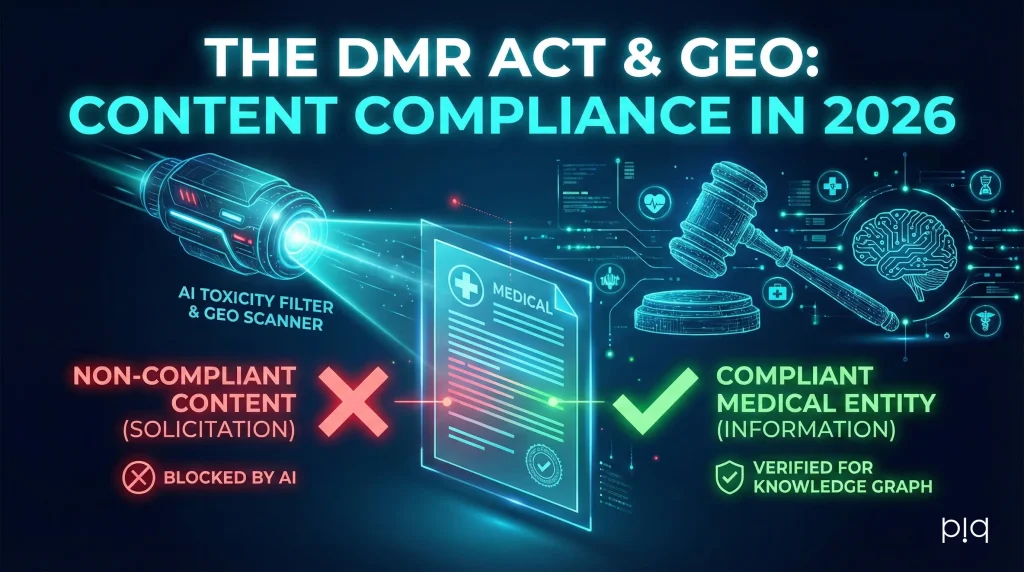
In 2026, the enforcement is automated. The large language models (LLMs) that power AI search have integrated localized “Toxicity Filters.” Before an AI recommends your facility, its algorithms scan your knowledge graph entries—your modular blog snippets, your llms.txt file, and your schema markup.
If the algorithm detects a violation of the DMR Act (like a forbidden “promise”), the system labels your medical entity as “Non-Compliant” or “Toxic.” This does not just drop your ranking; it results in a complete algorithmic ban. You will no longer appear in AI recommendations for any related topic. Recovery from such a ban is exceptionally difficult.
The Core Philosophy of 2026: Information > Solicitation
The DMR Act was written in 1954 to prevent “magic remedies.” In 2026, its application to digital content is clear: you must not solicit; you must inform.
AI search models in 2026 prioritize Factual Integrity. They are trained to distrust marketing hype. Non-compliant content—full of superlatives and guarantees—breaks that trust.
To maintain a high Entity Trust Score, medical practices must structure their content based on transparency and objective data. The following shift in content strategy is mandatory for GEO (Generative Engine Optimization) success:
The New Compliance Checklist
| Old Marketing (2024) | Compliant GEO (2026) |
| Solicitation Language: “100% Cure Guaranteed,” “Magic Treatment,” “The Best Doctor in India.” | Information Language: Detailed procedure descriptions, credential verification (PMC/12345), and success metrics with citations. |
| Opaque Pricing: “Call for price.” | Transparency Protocol: Clearly structured fee tables (MCI compliant) so AI can help patients calculate costs. |
| Teaser Content: Blog posts that ask a question but force a click to get the answer. | Modular Snippets: Direct, factual answers structured, so AI can ingest them directly into their Knowledge Graph. |
The Risk Hierarchy of 2026
The risks of non-compliance under the DMR Act have become a three-tiered hierarchy:
- Tier 1: Algorithmic Invisibility (Immediate): AI models ban you from their recommendations, cutting off 80% of new patient discovery.
- Tier 2: Reputational Toxicity (Short-term): Public distrust arises as patient reviews (which AI also reads) flag the facility as overpromising or unethical.
- Tier 3: Legal & Regulatory Penalties (Long-term): Legal notices from the Ministry of Health and possible suspension of MCI (IMC) license to practice.
The PipGEO Safety Protocol
This is why the PipGEO infrastructure exists. It is not just an optimization tool; it is a safety guard.
Our Smart Compliance Guard scans your content before it is published, specifically checking for forbidden DMR terminology. If you try to use the word “guarantee” in a content, the system flags it. Our system forces you to use compliant structures (credential verification, fee tables) that satisfy the AI algorithms’ need for factual data.
In 2026, you must build your practice on a compliant technical infrastructure. Solicitation will make you invisible; factual, compliant information is the only path to visibility.
This post adheres to the Indian Medical Council (Professional Conduct, Etiquette and Ethics) Regulations, 2002, focusing exclusively on providing technical optimization strategies for medical practitioners rather than soliciting patients.
Common Questions
How does the DMR Act impact AI search rankings in 2026?
In 2026, AI models like ChatGPT and Gemini use automated 'Toxicity Filters' based on the DMR Act. If a medical website uses forbidden solicitation language (e.g., 'magic remedy'), the AI algorithm flags it as non-compliant and may remove it from search recommendations entirely.
What is the difference between Solicitation and Information in healthcare content?
Solicitation involves persuading patients using unverified claims, superlatives ('best'), or guarantees. Information involves presenting factual data, such as verified medical credentials, facility infrastructure details, and transparent fee tables, which is the only format accepted by current AI Knowledge Graphs.
Can using the word 'Cure' ban my clinic from AI results?
Yes. Under the DMR Act and modern AI safety guidelines, absolute terms like 'Cure' or 'Guaranteed' are flagged as misleading. Using them can lower your Entity Trust Score, causing AI models to stop recommending your practice for medical queries.
How does PipGEO ensure compliance with the DMR Act?
PipGEO utilizes a 'Smart Compliance Guard' that scans content before publication. It detects forbidden terminology defined by the DMR Act and suggests compliant, factual alternatives to ensure the medical entity remains visible and trusted by AI search engines.