If you’ve noticed a dip in your organic click-through rates despite stable rankings, you aren’t alone. The search landscape is undergoing its biggest shift since the invention of the keyword. We are moving from the era of Search Engine Optimization (SEO) to Generative Engine Optimization (GEO). With “LLM Optimization” search volume skyrocketing across marketing forums and tech blogs, businesses are scrambling to understand how to stay visible when an AI—not a human—is the primary reader of their content. Here is what you need to know to adapt.
What is LLM Optimization (GEO)?
Generative Engine Optimization (GEO) is the process of optimizing your content to increase the likelihood of being cited, quoted, or recommended by Large Language Models (LLMs) like ChatGPT, Claude, Gemini, and Perplexity.
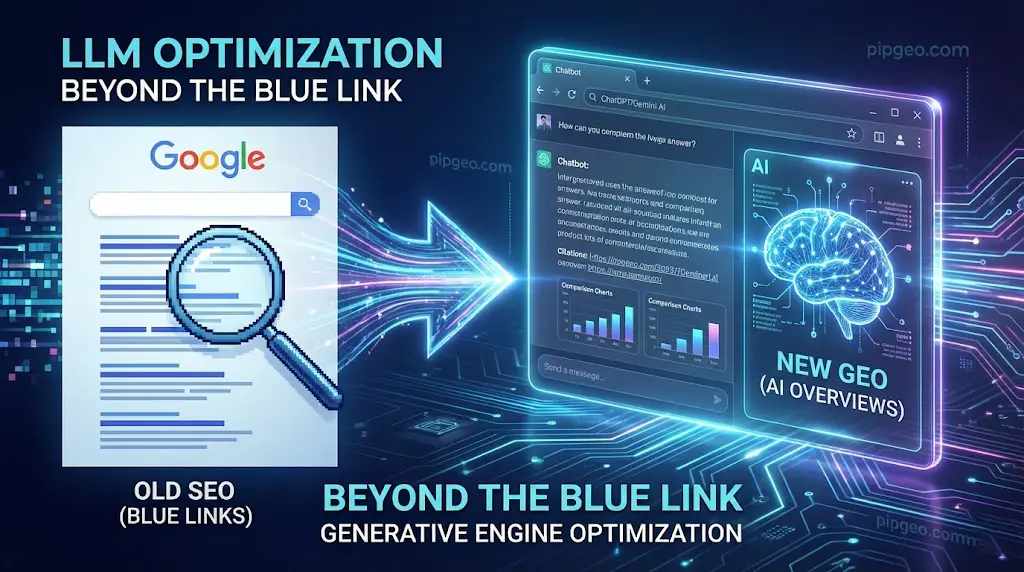
Unlike traditional SEO, which fights for a spot on a list of links, GEO fights for share of voice in a conversational answer. The goal isn’t just to rank; it’s to be the verified fact the AI relies on to construct its response.
Why It Matters Now
The behavior of searchers is changing. By 2026, Gartner predicts that traditional search engine volume could drop by 25% as users turn to conversational AI assistants.
- Zero-Click Reality: Users are getting answers directly in the interface without clicking through to a website. If you aren’t the source the AI cites, you are invisible.
- The “Trust” Economy: LLMs prioritize credibility. They are programmed to reduce hallucinations by leaning on authoritative, data-backed sources. If your content is “fluff,” the AI ignores it.
How to Optimize for LLMs: 5 Actionable Strategies
To capture this new search volume, you must structure your content the way machines prefer to read it.
Implement llms.txt
Just as robots.txt tells Google where to look, llms.txt is a proposed standard file that gives AI crawlers a clean, code-free list of your most important content.
- Why it works: It strips away HTML clutter (ads, sidebars, pop-ups) and feeds the AI your raw, high-quality text. This saves the bot’s “token budget” and increases the chance of accurate indexing.
Prioritize “Information Gain” Over Keywords
AI models are trained to detect and ignore generic, repetitive content. To be cited, your content must provide Information Gain—unique data, stats, or perspectives that exist nowhere else.
- The Tactic: Instead of writing “5 Tips for Marketing,” write “New Survey Data: 5 Marketing Tactics with 20% Higher ROI.”
- Avoid “Fluff” Words: LLMs lower the trust score of content filled with vague buzzwords like delve, comprehensive, game-changing, and landscape. Be concise and factual.
Structure for “Direct Answers”
LLMs build answers by assembling facts. Make your content a database of facts they can easily extract.
- Use Definition Pairs: Immediately follow a heading (e.g., “What is GEO?”) with a direct, concise definition.
- Lists and Tables: AI models love structured data. Use bullet points for steps and comparison tables for product reviews.
- Quotes and Citations: Include quotes from recognized experts. AI uses these as “trust signals” to verify your content’s authority.
Optimize for “Search Everywhere”
LLMs don’t just crawl websites; they train on Reddit threads, Quora answers, YouTube transcripts, and LinkedIn posts.
- The Strategy: Don’t just publish on your blog. Distribute your core insights across platforms where human discussion happens. If an AI sees your brand mentioned positively in Reddit threads and LinkedIn comments, it associates your entity with authority.
Lean into E-E-A-T (Experience, Expertise, Authoritativeness, Trustworthiness)
Google’s E-E-A-T guidelines are doubly important for AI. Models are fine-tuned to prefer content written by verifiable experts.
- Action: Ensure every blog post has a clear author bio with links to their LinkedIn or other publications.
- Cite Sources: Link to primary data sources. It signals to the AI that your content is grounded in reality, not hallucination.
The Future: Measuring Success
You can no longer rely solely on “Rank Rankings.” In the GEO era, new metrics are emerging:
- Share of Model: How often is your brand mentioned when a user asks a category-level question (e.g., “Best CRM for small business”)?
- Citation Frequency: How often does the AI link to your site as a footnote?
The transition to LLM-first search isn’t coming—it’s already here. By shifting your focus from “keywords” to “authority,” you ensure your brand survives the shift from search bars to chat windows.